Showing posts with label Art Movements. Show all posts

Monday, September 5, 2016

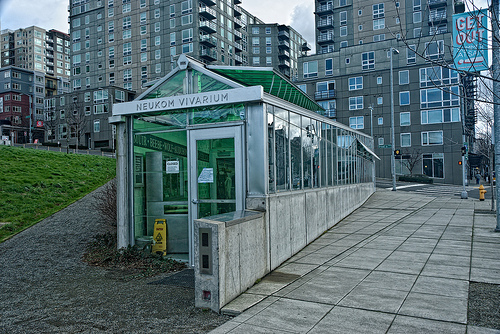
NEUKOM VIVARIUM BY MARK DION (2008)
"Process Art can survive for much longer."
Mark Dion calls attention to a lengthier process in Neukom Vvarium a hybrid work of sculpture, architecture, and horticultutre (=the art or practice of garden cultivation and management) installed at the Olympic Sculpture Park in Seattle. Dion removed a sixty foot long section of a fallen hemlock log from its forest ecosystem and placed it in a custom designed greenhouse, where it continuous to decay while supporting various life forms (bacteria, fungi, lichen, insects, plants).


Friday, September 2, 2016

Chapter One - The Ethics of Earth Art


This is a PDF of the first chapter of The Ethic of Earth Arts by Amanda Boetzkes. It analyzes the development of the earth art movement, stating that artists are connected through their clarification of the earth as a domain of ethical concern. It's a contrast between the human world and the earth; how earth art mediates the sensations of nature while allowing nature itself to remain irreducible to human signification.

Robert Smithson - "A Sedimentation of the Mind: Earth Projects"

In this essay, Smithson discusses the necessity for art to break physical boundaries by analyzing the relationship of materials and the art-historical context of several works. He finds parallels between aspects of the human mind and certain terrains and environments, and mentions how industry and commodity have affected the existence and making of objects negatively. It's a bit wordy, and he throws in some wild metaphors that I don't follow, but it seems to cover the main philosophical ideas behind land art with considerable depth.

https://monoskop.org/images/5/5c/Smithson_Robert_1968_1979_A_Sedimentation_of_the_Mind_Earth_Projects.pdf

How to post to this blog

Hi Class,

Here are a few guidelines for posting to our project blog.:

  1. Keep it to information directly related to our course.
  2. Be sure to tag (using the labels feature on the right sidebar of the edit window) when you are posting. 
  3. Edit/add information to posts instead of making multiple posts on the same subject. Ex. instead of having two (or more) different posts on Richard Long, add all Richard Long info to the first post anyone made on that artist.
  4. Use a title for your posts that will be helpful
  5. In a short paragraph at the top of the post, please state the main idea and connection to our project when posting. This can be a one-liner or a few sentences. 
  6. Add hyperlinks to texts and available pdf's on-line. 
  7. Don't forget to hit the orange "publish" button when posting. 
Below is a list of labels we will use to organize our posts, if there are others that may be appropriate please add them. Use as many labels as are necessary to catalogue your post:

Artists
Collectives
Collaborations
Projects
Sites
Residencies
Institutions
Grant Opportunities
Art Movements
Materials
Texts
Locals Only
Topical Research- this is the place to put any resources that are related to our topic (landscape and site) but have not bee connected directly to the art world. Examples include ecology, landscape design, urban planning, philosophy, cultural geography, etc. Please be sure to write a good summary on how it relates specifically to our project. If things get too broad, it will make it difficult to use this blog for its intended purpose.